


What is Gaia-X?
Gaia-X is creating an ecosystem of interconnected data spaces where data can be linked, securely shared, and easily transferred between different systems through established standards and open interfaces. Gaia-X aims to promote secure data sharing within Europe, support collaboration in the field of artificial intelligence, and create a common European data infrastructure to strengthen European data sovereignty.
The Gaia-X 4 Advanced Mobility Services (Gaia-X 4 AMS) project demonstrates how Gaia-X can be used to implement the mobility services required for autonomous driving and which components need to be newly developed as part of Base-X.
OECON prepares the necessary data structures for highly dynamic routing and the converter used for communication with vehicles.
The Gaia-X 4 AMS project is part of the gaia-x4futuremobility project family in the mobility domain of the Gaia-X Hub Germany and is funded by the Federal Ministry for Economic Affairs and Energy (BMWE).

As part of the project, static (traffic signs, construction zones, etc.) and dynamic map data (weather, traffic conditions, etc.) are processed and made available via the Urban Data Platform on the Internet as well as through the infrastructure using Wi-Fi-based ITS-G5 communication.

EDDY received funding from the German Federal Ministry of Transport and Digital Infrastructure (BMV) as part of the mFUND innovation initiative.

The goal of the ViVre project was to interconnect virtualized traffic infrastructure and automated driving functions for key traffic hubs in order to develop building blocks for innovative and sustainable mobility solutions. In particular, concepts for new virtual stops were developed, implemented in road traffic, and evaluated. In the process, new integrated functions for automated, connected vehicles and virtualized infrastructure were developed.

The Vivre project received funding by the Federal Ministry of Transport and Digital Infrastructure (BMV)

The Lower Saxony Test Field is an open research platform that will be made available to partners from industry and research for individual testing and research purposes related to the development and testing of automated and connected vehicles. The DLR will gradually install the necessary technology for this on highways 2, 7, 391, and 39, as well as on federal and state roads.

The Lower Saxony Test Field received funding by: the Lower Saxony Ministry of Economic Affairs, Labor, Transportation, and Digitalization; the Lower Saxony Ministry of Science and Culture, with funding from the European Regional Development Fund (ERDF); and the State of Lower Saxony

Automated and Connected Driving in the City
The goal was to develop digital solutions for traffic intersections with mixed traffic (automated and non-automated vehicles, cyclists, and pedestrians) in urban areas. To this end, a digital test bed—AIM (Intelligent Mobility Application Platform), which had already been set up by the DLR in Braunschweig in 2014 for research purposes—was utilized and expanded.

The “Digital Hub 4.0” project was funded by the Federal Ministry of Transport and Digital Infrastructure (BMV).

As a member state of the C-Roads cooperation, Germany has developed, tested, and refined seven different C-ITS services under the supervision of the BASt (Federal Highway Research Institute). The results were incorporated into the European C-Roads platform. Through this contribution, “C-Roads Germany” supported the Europe-wide and cross-border rollout of C-ITS services.

The C-Roads project was funded by the European Union.

The ANIKA project aimed to enable emergency call boxes to communicate with passing vehicles. In addition to the technical specifications, ANIKA focused on determining which V2I services should be supported by emergency call boxes. In the future, emergency call boxes equipped with V2I technology could even be used to send warning messages (e.g., about wrong-way drivers) to other drivers and the traffic management center.
 Bild: querbeet / Getty Images
The ANIKA project was funded by the Lower Saxony Ministry of Economic Affairs, Labor, and Transportation.

The GENEVA project developed proactive and scalable assistance systems specifically tailored to complex urban traffic situations. These assistance systems enhance and improve traffic safety in urban areas for all road users.
The demonstration vehicle was equipped with sensors for vehicle dynamics, environmental perception, and communication.
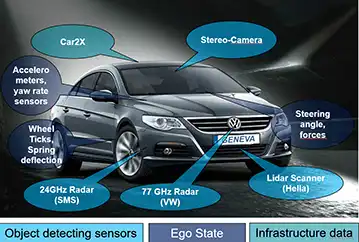
The project was funded by the former European GNSS Agency.

In FAMOS 2, the systems defined in FAMOS 1 for GALILEO-based, safety-critical driver assistance systems and mobility services were further developed and implemented as prototypes. FAMOS 2 integrated conventional sensors with the advantages of GALILEO and consistently applied them in new applications.
The project was funded by the former Federal Ministry of Economics and Technology (BMWi). (Now Federal Ministry for Economic Affairs and Energy (BMWE))

The GAMAA-A project developed a concept and a prototype for a low-cost, three-frequency satellite receiver (Galileo/EGNOS/GPS) that meets the automotive industry’s stringent requirements for highly precise and reliable positioning.

The project was funded by the former European GNSS Agency.

NetFCD stood for “Network-based Floating Car Data” and described a method for detecting traffic congestion by using cell phones on highways and federal highways. The system took advantage of the fact that cell phone calls made while driving must be “handed off” from one base transceiver station (BTS) to the next when the phone leaves the BTS’s coverage area.
Traffic flow information (Floating Car Data) can thus be determined virtually in real time and without the need for complex calculations from individual sensors.

Development of a positioning module for:
- Passive assistance systems / warning systems
- Active assistance systems / comfort systems
- Safety-critical assistance systems / safety systems
It was demonstrated that, by implementing automotive-specific software on a low-cost GPS chipset, it is possible to achieve reliable and stable GPS positioning. It became apparent that the limitations of satellite-based positioning, particularly in urban areas, can be overcome by combining it with additional vehicle sensors. Therefore, preparations were made to integrate additional sensors (e.g., gyroscope, odometer).
Client: Volkswagen AG

The goal of FAMOS 1 was the targeted integration of Galileo into future safety and information concepts for driver assistance systems, as well as the development of new systems, processes, and solutions for location-based mobility services.
As part of the FAMOS 1 project, OECON was responsible for the area of positioning and communication technologies and handled the overall system architecture.
 The project was funded by the former Federal Ministry of Economics and Technology (BMWi). (Now Federal Ministry for Economic Affairs and Energy (BMWE))

The TrafficOnline project focused on developing an innovative, globally applicable method for the online detection of traffic conditions that can be used anonymously without disrupting users of a cellular network (GSM/UMTS).
The project was funded by the former Federal Ministry of Education and Research. (Now: Federal Ministry of Research, Technology and Space (BMFTR))